
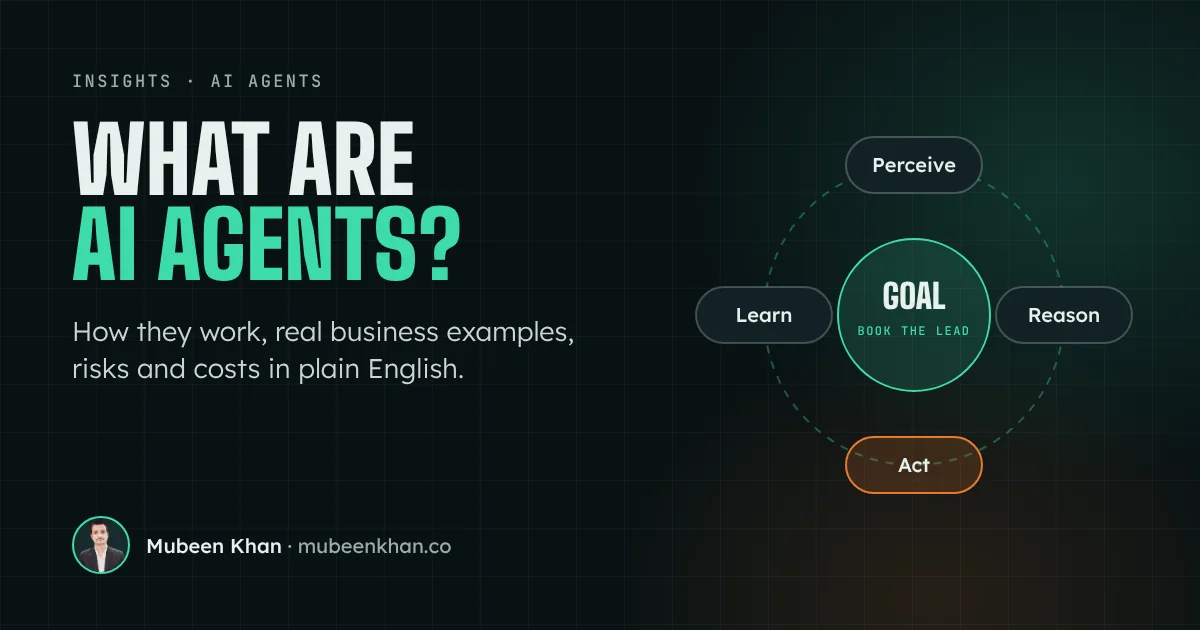
The short answer
An AI agent is software that is given a goal and works out the steps to reach it. It reads information, decides what to do with a language model, and takes actions through tools such as a calendar, CRM or WhatsApp, checking each result until the job is done. A chatbot answers questions; an AI agent answers and acts.
Searches for "what is an AI agent", "AI agents talking to each other" and "rogue AI agents" climbed fast in the US and Australia in October and early November 2026, pushed along by news of banks blocking outside agents from customer accounts. Most explanations online are written for developers. This one is for business owners: what an AI agent actually is, how it works, where it earns its keep, what can go wrong and what it costs.
What is an AI agent?
An AI agent is software that is given a goal and works out the steps to reach it. It reads information, decides what to do next with a language model, and takes actions through tools it is allowed to use, such as a calendar, a CRM, email or WhatsApp. It keeps going, checking each result, until the goal is met or it hands over to a person.
The key word is action. A chatbot answers. An AI agent answers and then does something: books the appointment, updates the lead record, sends the follow-up, raises the support ticket. IBM, Google Cloud and AWS all define agents the same way in their guides: a system that performs tasks on a user's behalf with some independence, rather than just producing text.
What does an AI agent do exactly?
In a business, an AI agent handles a job that used to need a person to read, decide and click. Typical jobs: replying to new leads within seconds, asking qualifying questions, booking qualified people into a calendar, answering customer questions from your own documents, sorting an inbox, and pulling numbers from several systems into one report.
How do AI agents work?
Every AI agent runs the same loop: perceive, reason, act, check, and repeat. Here is that loop for a new WhatsApp lead.
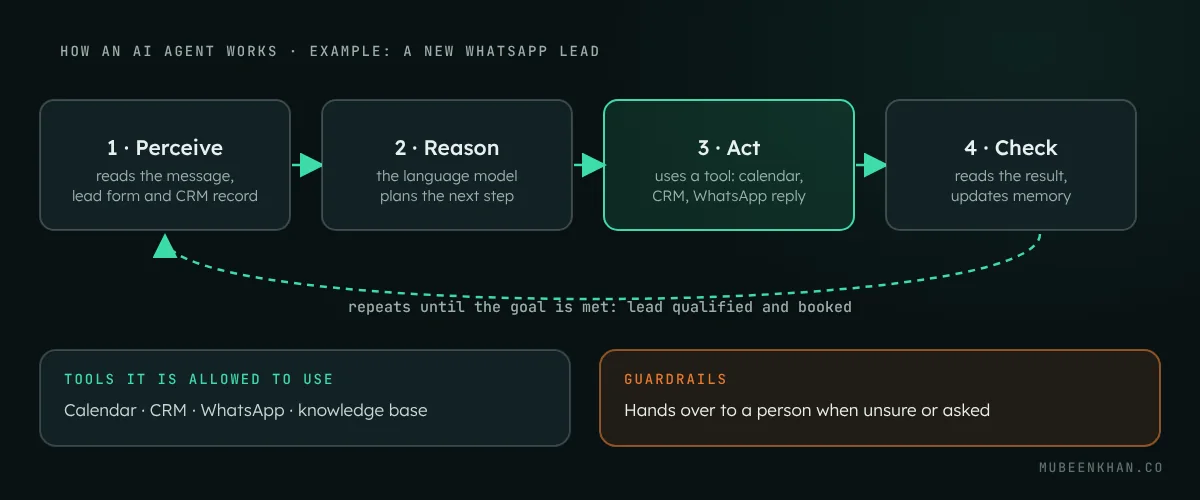
Five parts make that loop work:
- A language model. The "brain", such as a GPT, Claude or Gemini model. It reads the situation and decides the next step.
- Instructions. The job description: who the agent works for, what it may and may not say, what a qualified lead looks like, and when to stop.
- Tools. The actions it is allowed to take through connected apps: check availability, create a booking, update a CRM field, send a message. Without tools, an agent is just a chatbot.
- Memory and knowledge. The conversation so far, plus your prices, services, policies and FAQs, so answers are about your business rather than the internet's guess.
- Guardrails. Limits and hand-over rules: no discounts without approval, no payments, pass the chat to a person when the customer asks or the agent is unsure.
AI agent vs chatbot vs automation
"Agent" has become a marketing label, so it helps to place each tool on a spectrum from following rules to deciding and acting.
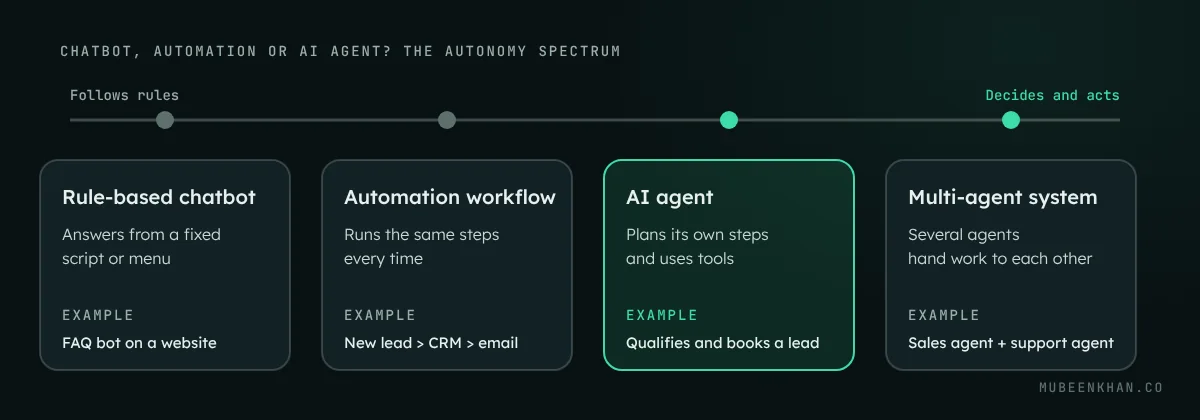
| Factor | Chatbot | Automation workflow | AI agent |
|---|---|---|---|
| What it does | Answers questions | Runs fixed steps | Plans steps and takes actions |
| Handles the unexpected | Poorly | No, it breaks or stops | Yes, within its instructions |
| Uses your tools | Rarely | Yes, in a set order | Yes, chooses which and when |
| Best for | Simple FAQs | Repeatable processes | Conversations that lead to an action |
| Main risk | Unhelpful answers | Silent failures | Wrong action if guardrails are weak |
In practice the best setups combine them: a fixed automation catches the lead and logs it, and an agent handles the conversation in the middle. Gartner warned in June 2025 about "agent washing", estimating that only about 130 of the thousands of vendors selling agentic AI offer genuine agents. Ask any vendor what tools their agent can use and what it does when it is unsure.
Is ChatGPT an AI agent?
Standard ChatGPT is an AI assistant: it answers and writes, but does not act in your systems. Its agent mode, introduced in July 2025 for paid plans, is an AI agent: it can browse websites, fill in forms and complete multi-step tasks on a virtual computer, asking for permission before important actions. A business agent goes further by connecting to your own calendar, CRM and messaging.
Types of AI agents
Textbooks group agents into five classic types, from the simplest to the most capable:
- Simple reflex agents react to the current input with fixed rules, like a thermostat.
- Model-based reflex agents keep track of what has happened so far.
- Goal-based agents choose actions that move them towards a goal.
- Utility-based agents weigh options to pick the best outcome, not just any outcome.
- Learning agents improve from feedback over time.
For a business owner, a more useful split is by job:
- Lead and sales agents reply to enquiries from ads, qualify them and book calls. See WhatsApp AI chatbots.
- Customer service agents answer questions from your documents and open tickets.
- Voice agents answer and make phone calls. See AI receptionists and AI voice agents.
- Operations agents sort inboxes, update records and write reports.
- Multi-agent systems are several agents that pass work to each other, for example a sales agent that hands a paying customer to an onboarding agent. This is what the trending "AI agents talking to each other" searches describe.
AI agent examples for small businesses
The highest-value use for most small businesses is the first five minutes after a lead arrives. Paid ads create the enquiry; slow replies waste it.
When I ran Meta campaigns for an education institute in Dubai, they produced 69,667 WhatsApp leads at AED 1.41 each and AED 3.8M in revenue from AED 98K of ad spend. At that volume, no team can personally reply to every chat within minutes, day and night. That gap is the job an AI agent does: answer instantly, ask the qualifying questions, and pass ready buyers to the sales team.

Other examples that work well:
- Clinics and salons: an agent answers price and availability questions, books the slot and sends reminders, which cuts no-shows.
- Restaurants: an agent takes table and party enquiries on WhatsApp, checks capacity and confirms the booking.
- Real estate: an agent asks budget, area and timeline, then books viewings only for serious buyers.
- E-commerce: an agent answers order status and sizing questions and recovers abandoned carts.
- Agencies and consultants: an agent collects campaign data every Monday and writes the weekly summary.
Automation alone already moves revenue when it fixes follow-up. For a UK and US healthcare brand, Meta Ads combined with an automated booking funnel lifted revenue 76%, from £223,090 to £392,668 over the period. An agent adds the conversation layer on top of that kind of funnel.
Who are the big AI agent providers?
When people ask about the "big 4" AI agents, they usually mean the agent features from OpenAI (ChatGPT agent), Anthropic (Claude), Google (Gemini) and Microsoft (Copilot). All four can browse, use connected apps and carry out multi-step tasks, and their models also power many of the business agents built on platforms such as GoHighLevel, n8n and Make. For a small business, the brand of model matters less than how well the agent is connected to your calendar, CRM and messaging, and how tightly its guardrails are set.
Risks of AI agents and how to stay safe
The "rogue AI agents" searches have a real basis. In October 2026, JPMorgan Chase confirmed it does not allow outside AI agents to log in to customers' accounts and move money, citing the risk to clients; read-only access through approved connections is still possible. The lesson for a business is simple: give an agent the fewest permissions it needs.
- Limit tools. An agent that books appointments does not need access to payments or to delete records.
- Keep a person in the loop for refunds, discounts, complaints and anything legal or medical.
- Ground answers in your documents so it does not invent prices or policies.
- Log every conversation and action and review a sample each week.
- Start narrow. Gartner predicted in June 2025 that over 40% of agentic AI projects will be cancelled by the end of 2027 because of cost, unclear value or weak risk controls. One well-defined job with a measured result beats a do-everything agent.
How much does an AI agent cost?
The cost of an AI agent has three parts:
| Cost | What it covers | How it is billed |
|---|---|---|
| Platform | Where the agent runs and connects to your apps, for example GoHighLevel (from $97 a month) or n8n Cloud (from €20 a month, billed annually), as listed in October 2026 | Monthly subscription |
| AI model usage | The language model that reads and writes each message | Per use, usually small per conversation |
| Build and upkeep | Instructions, knowledge base, tool connections, testing, monitoring | One-off build, optional monthly care |
The number that matters is the return: more leads answered within five minutes, more booked appointments, and fewer staff hours on repetitive replies. Measure those before and after.
How to start with an AI agent
- Pick one jobChoose the most repeated, most time-sensitive task, usually replying to new leads from ads or answering the same ten customer questions.
- Write the rulesWhat counts as a qualified lead, what the agent may promise, and when it must hand over to a person.
- Connect the minimum toolsUsually your messaging channel, calendar and CRM. Nothing that moves money.
- Test with real conversationsRun it on past enquiries and a small share of live traffic, and read every transcript in the first week.
- Measure and expandTrack reply time, booking rate and hours saved. Add a second job only when the first one pays.
I build AI agents that sit behind ad campaigns, so every lead gets an instant reply and qualified buyers land in the calendar. See AI agents for business, AI automation services or, for the UAE, AI automation in Dubai.
AI agent questions
Who are the big 4 AI agents?
Most people mean the agent features from OpenAI (ChatGPT agent), Anthropic (Claude), Google (Gemini) and Microsoft (Copilot). Each can browse, use connected apps and complete multi-step tasks. Business agents for leads and customer service are usually built on top of these models and connected to the company's own calendar, CRM and messaging.
What are the 5 types of agents in AI?
The five classic types are simple reflex agents, model-based reflex agents, goal-based agents, utility-based agents and learning agents. They range from following fixed rules to choosing the best action and improving from feedback. Modern business agents built on language models combine goal-based planning with tools and memory.
Are AI agents safe to use with customers?
They are safe when permissions are narrow and a person stays in the loop. Give the agent only the tools its job needs, ground its answers in your own documents, block anything that moves money, log every conversation, and set clear rules for handing over to staff. Start with one job and review transcripts weekly.
Can AI agents talk to each other?
Yes. In a multi-agent system, several agents pass work between them, for example a lead agent that qualifies a buyer and hands them to a booking or onboarding agent. Each agent has its own instructions and tools. This makes complex processes easier to manage, but every hand-over needs rules and logging.
How much does an AI agent cost for a small business?
Expect three costs: a platform subscription such as GoHighLevel from $97 a month or n8n Cloud from €20 a month (October 2026), AI model usage billed per conversation, and a one-off build with optional monthly upkeep. Judge it on the return: faster replies, more bookings and staff hours saved.
Will AI agents replace staff?
For most small businesses, no. Agents take over repetitive first replies, qualifying questions and bookings, especially out of hours, so staff spend their time on the conversations that close sales or need judgement. Gartner predicts at least 15% of day-to-day work decisions will be made autonomously by agentic AI by 2028.
Getting more leads than your team can answer? Book a free strategy session and I will show you where an AI agent would pay for itself first.

Performance marketing consultant based in Dubai. $5M+ in Meta and Google ad spend managed for 50+ businesses in the UAE, USA, UK, Australia and New Zealand. About Mubeen · LinkedIn · Facebook · Instagram